All fields General work - Free

TL^5888(2) Free aptitude test

A free psychotechnical test simulates real test conditions and allows you to experience aptitude tests and pre-employment selection tests, helping you understand and become familiar with the types of questions found in psychotechnical tests.

On this page, you can choose from a variety of free psychotechnical tests available in multiple languages and become familiar with the test environment used in screening and recruitment processes.

For your convenience, next to each test you will find the relevant skills or traits it assesses.
Tests for the position of Free aptitude test
Aptitude tests Skills
Skills test Tests
To view errors, go to the card then press the button show mistakes.
Example Skills (Traits) Report of
Free aptitude test
3
3
7
3
General average
A general mathematical average of all tests tested, it is important to understand that there are tests of different importance and therefore the average does not necessarily reflect the level of the examiner in the position.
Overall Accuracy
The level of accuracy achieved relative to the number of questions solved, and compared with the general population. The higher the level of accuracy, the more accurately the person works on tasks that require thinking.
Overall Work Pace
The number of questions answered within the allocated time limit, relative to the general population. The higher the score, the faster the work pace in tasks that require thinking.
Relies on a single test
General cognitive ability, reflecting the ability to learn, absorb, process and use information, acquire new skills, and cope with intellectual challenges.
Trait-related tests
Number Sequences 3
General numerical aptitude, including the ability to perform basic arithmetic operations quickly and accurately, estimate numerical values, and use mathematical thinking and reasoning.
Trait-related tests
Number Sequences 3
The ability to quickly and efficiently perform simple, monotonous tasks that require attention, concentration, attention to detail, and accuracy.
Trait-related tests
Sequence Matching 7
Relies on a single test
The ability to analyze different types of data and draw actionable conclusions from them.
Trait-related tests
Number Sequences 3
Example Skills (Exams) Report of
Free aptitude test
output: 116.0% Time Utilization: 76.9%
Number Sequences
started : 18/10/21 14:45 | ended : 18/10/21 14:53
norm: כל ההשכלות
Score
9 correct answers from 0
Accuracy
9 correct answers from what was done 12
Work pace
12 answers from 0
Number Series Test examines the ability for inductive and deductive reasoning. Reasoning has been considered a critical component of human intelligent for decades. To separate the ability to perform complex arithmetic calculations from numerical reasoning, one needs to use only the 4 basic arithmetic operations, thus, an item's level depends on the difficulty of identifying the underlining rule.
3
3
3
Used: 54% out of 15 minutes
started : 18/10/21 14:45 | ended : 18/10/21 14:53
Number Series Test examines the ability for inductive and deductive reasoning. Reasoning has been considered a critical component of human intelligent for decades. To separate the ability to perform complex arithmetic calculations from numerical reasoning, one needs to use only the 4 basic arithmetic operations, thus, an item's level depends on the difficulty of identifying the underlining rule.
Sequence Matching
started : 24/08/20 10:11 | ended : 24/08/20 10:15
norm: 11-12 years (Full secondary education)
Score
45 correct answers from 50
Work pace
46 answers from 50
The "Sequence Matching" test measures a person's ability to work accurately and quickly in identifying differences between simple stimuli. This type of skill is important in administrative and clerical jobs of various kinds; however, accurate work is also required in tasks such as programming, actuarial work, information systems management, and more.
7
Used: 100% out of 4 minutes
started : 24/08/20 10:11 | ended : 24/08/20 10:15
The "Sequence Matching" test measures a person's ability to work accurately and quickly in identifying differences between simple stimuli. This type of skill is important in administrative and clerical jobs of various kinds; however, accurate work is also required in tasks such as programming, actuarial work, information systems management, and more.
skills
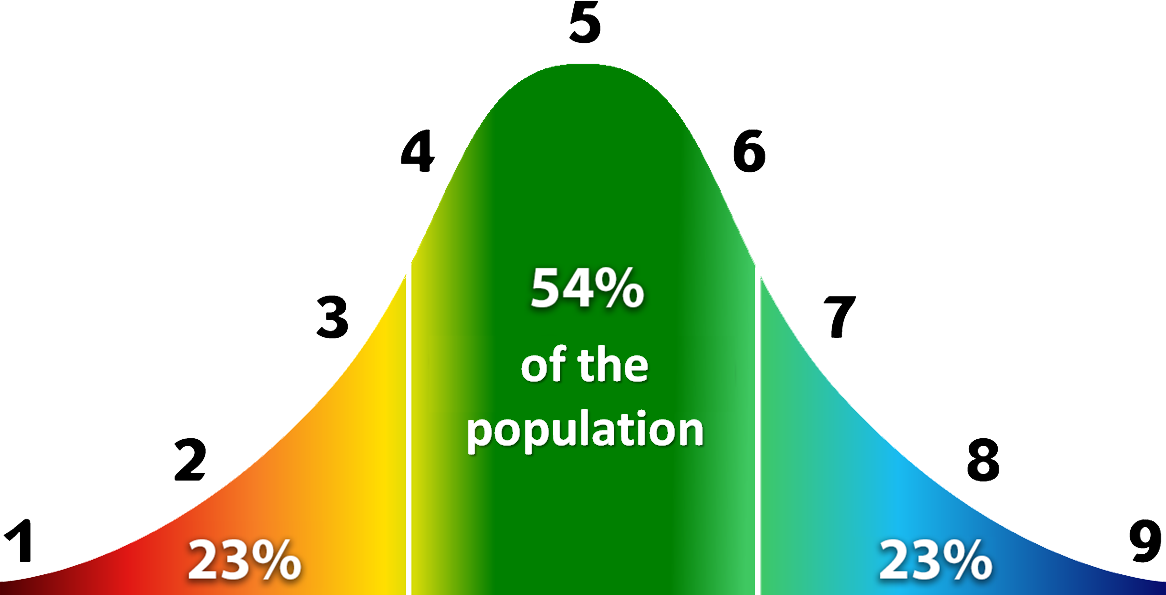
(9 sections distribution)
9 very high (4%)
 
4%
9) Percentiles 96-100, ~4% are the highest marks, ~96% scored lower (4% achieved this exact score) - approximately 4% of the population is at this level, indicating they are elite individuals.
8 high (10%)
 
7%
8) Percentiles 89-96,~4% attained a higher score,~89% attained a lower score (7% attained exactly this score) -~approximately 10% of the population is at this score (or higher), meaning only a few people reach this score or above.
7 above average (23%)
 
12%
7) Percentiles 77-89, ~11% scored higher, ~77% scored lower (12% scored exactly this score) - about 1/4 of the population is at this score (or higher), meaning a small part of the population.
6 high average (40%)
 
17%
6) Percentiles 60-77, ~23% achieved a higher score, ~60% achieved a lower score (17% achieved exactly this score) - ~about 40% of the population falls within this score (or higher), meaning the level is slightly above average.
5 average (50%)
 
20%
5) Indicator 40-60%, ~ 40% got a higher score, ~ 40% got a lower score (20% got this exact score). ~ This is an average score, half of the candidates get a higher score and half a lower score.
4 low average (60%)
 
17%
4) Percentile 23-40%, ~60% scored higher, ~23% scored lower (17% scored exactly at this score). -~Around 60% of the population achieved higher than this level, meaning this level is slightly below average.
3 below average (75%)
 
12%
3) Percentiles 11-23%, ~77% scored higher, ~11% scored lower (12% achieved exactly this score) -~approximately 3/4 of the population achieved higher results than this level.
2 low (90%)
 
7%
2) Percentiles 4-11%, ~89% reached a higher score, ~4% reached a lower score (7% reached this exact score) - ~90% of the population achieved higher results than this level.
1 very low (96%)
 
4%
1) Indicator 0-4%, ~ 4% below points, ~ 96% achieved a higher score (4% achieved exactly this point) - ~ Almost all candidates received higher scores than this level.

The [9] Scale: Represents the percentile of population that will reach or surpass this grade.
This implies the majority of the population will score 4, 5 or 6 and only a fraction will score 9 or 1.

personality
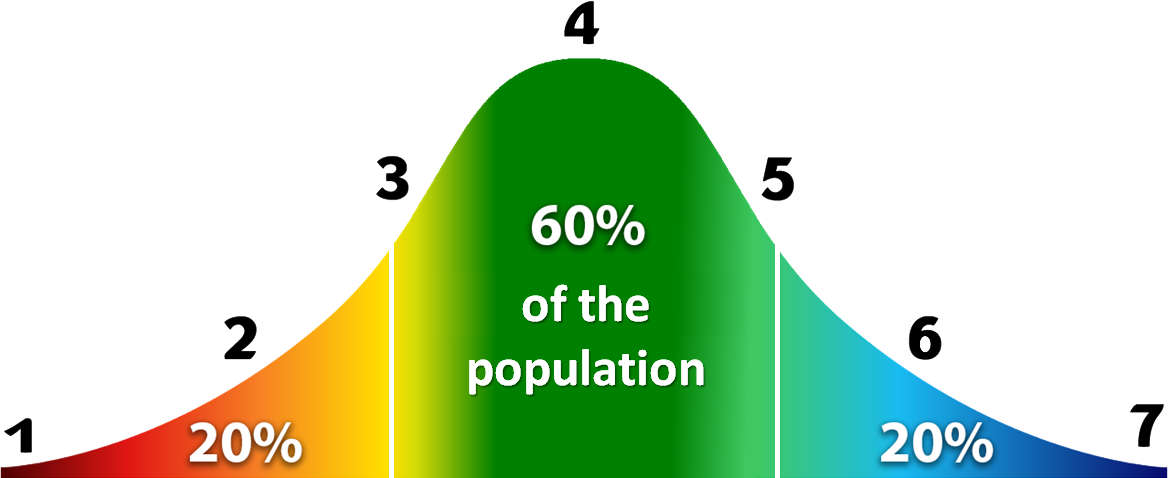
(7 sections distribution)
7 Very high (5%)
 
5%
7) Percentiles 96-100%, the top 5% of the population, 95% scored lower (5% reached this exact score). About 5% of the population is at this level, indicating exceptional individuals.
6 High (15%)
 
10%
6) Percentiles 86-95%, 5% scored higher, 85% scored lower (10% scored exactly this) - about 15% of the population is in this score (or higher), meaning a small part of the population.
5 Average - High (35%)
 
20%
Percentiles 66-85%, 15% scored higher, 60% scored lower (20% achieved exactly this score). Approximately 35% of the population is at this score (or higher), meaning the level is slightly above average.
4 Average (50%)
 
30%
Masons 36-65%, 35% have a higher score, 35% have a lower score (30% have just scored) This is the average grade, half the people score higher and half lower score.
3 Average - Low (65%)
 
20%
3) Percentiles 16-35%, 65% achieved a higher score, 15% achieved a lower score (20% achieved exactly this score) approximately 65% of the population achieved higher achievements than this level, meaning the level is slightly below average.
2 Low (80%)
 
10%
2) Percentiles 6-15%, 85% scored higher, 5% scored lower (10% achieved exactly this score) approx. 85% of the population reached higher achievements than this level.
1 Very low (95%)
 
5%
Masters 0-5%, 5% lower grades, 95% scored higher (5% scored exactly), almost all examinees achieved higher levels than this.

The [7] Scale: Represents the percentile of population that will reach or surpass this grade.
This implies the majority of the population will score 3, 4 or 5 and only a fraction will score 7 or 1.

The Personality Report is based on research that observed how a person ranks himself, his views and the way others rate him.

The scores range from "very high" to "very low" and are statistically relative, i.e. "very high" is relatively high in comparison to the population and in other words reflects the fact that the majority of people rank lower in a specific metric.

Are the corresponding traits
The marked tests are required according to the profession you have chosen. You can remove tests at your discretion, but it is recommended to complete all of them.
Test language: English
Free practice now includes only 4 tests. To view more options click here
$ 0
Free practice now includes only 4 tests. To view more options click here
are the corresponding tests
 

The ability to successfully handle problems that are primarily verbal, and to analyze and understand complex verbal messages.

Understanding of basic mechanical and technical principles, simple machines, tools, and basic concepts in electricity.

The ability to analyze different types of data and draw actionable conclusions from them.

The level of knowledge and understanding in programming, ranging from fundamental concepts and basic code structures to more advanced principles, problem-solving techniques, debugging, and software development practices. The trait reflects the ability to understand, analyze, and write code, identify errors, apply programming logic, and solve technical problems. Programming knowledge may be assessed generally or in relation to specific programming languages.

Warning!
Proceed to Payment start a free trial

Sample aptitude test: question types, examples and answers

An aptitude test measures how you think, how accurate you are and how you work under time pressure, and sometimes your working style as well. Every test returns to a few fixed question types, and knowing them in advance takes most of the surprise out of the real exam. Below are the common types, each with a sample question, an explained answer and a tip. Then you can try a full test for free, under real exam conditions, at the top of this page.

Verbal analogies

Two words share a relationship, and you need to find a pair related in exactly the same way. These questions measure vocabulary and abstract thinking.

Sample question

Doctor : hospital = teacher : ?

  1. student
  2. school
  3. lesson
  4. board
Answer and explanation

Answer: school. The relationship is "the workplace of": a doctor works in a hospital, and a teacher works in a school. "Student" and "lesson" are both related to a teacher, but not in the same way.

Tip: Put the relationship into a short sentence before you look at the options, then test each option against that sentence.

Number series

A series of numbers follows a fixed rule, and you need to find the next number. These questions measure numerical reasoning and pattern recognition.

Sample question

What is the next number in the series?

2, 6, 12, 20, 30, ?

  1. 40
  2. 42
  3. 44
  4. 36
Answer and explanation

Answer: 42. The differences between the numbers grow by 2 at each step: 4, 6, 8, 10. So the next difference is 12, and 30 plus 12 is 42.

Tip: When the rule isn't obvious, write down the differences between the numbers. In most series, that is where the rule shows up.

Shape matrices

A grid of shapes that change according to a rule, with one empty cell. You need to choose the shape that completes it. These questions measure abstract reasoning and do not depend on language.

Sample question

Which shape belongs in place of the question mark?

  1. ●
  2. ■
  3. ▲
  4. ◆
Answer and explanation

Answer: the square. Every row and every column holds a circle, a square and a triangle, each exactly once. The bottom row already has a triangle and a circle, so the square is missing.

Tip: Check the rows first, then the columns. If the rule still doesn't show, look at what changes in each shape: number, size, colour or direction.

Following instructions

A written instruction with several conditions that you need to carry out exactly. These questions measure careful reading and working by rules.

Sample question

If 7 is greater than 4, choose the last letter of the word "table". Otherwise, choose its first letter.

  1. t
  2. e
  3. b
  4. l
Answer and explanation

Answer: e. 7 is indeed greater than 4, so the first part of the instruction applies, and the last letter of "table" is e.

Tip: Read the instruction to the end before answering, and note which condition holds. Most mistakes here are reading mistakes, not thinking mistakes.

Attention and accuracy

Lists of numbers, letters or names that you need to compare quickly to spot the differences. These questions measure attention to detail under time pressure.

Sample question

In how many of the pairs are both sides exactly the same?

4827 – 4827
39156 – 39165
7012 – 7012
88301 – 88031

  1. 1
  2. 2
  3. 3
  4. 4
Answer and explanation

Answer: 2. The first and third pairs are identical. In the second pair the digits 5 and 6 are swapped, and in the fourth the digits 3 and 0.

Tip: Compare digit by digit rather than the whole number at a glance. The eye fills in familiar numbers and misses swaps.

Numerical reasoning

Short everyday maths problems: percentages, ratios, speed and time. No advanced maths is needed, but you have to work fast and without a calculator.

Sample question

An item priced at $80 is reduced by 25%. What is its price after the discount?

  1. $55
  2. $60
  3. $65
  4. $70
Answer and explanation

Answer: $60. A quarter of 80 is 20, and 80 minus 20 is 60.

Tip: Turn convenient percentages into fractions: 25% is a quarter, 50% is a half and 20% is a fifth. That way you can work it out in your head.

Personality questionnaire

Statements about work habits and preferences, and you mark how well each one describes you. There are no right or wrong answers here.

Sample question

"I finish one task before I move on to the next." How well does this statement describe you?

  1. Very well
  2. Fairly well
  3. Not very well
  4. Not at all
Answer and explanation

There is no right answer here. The questionnaire looks at how you usually behave, and the same topic comes back in several wordings to check consistency. Answers based on what seems desirable, rather than on what actually happens, tend to contradict each other.

Tip: Answer quickly and honestly, by what you actually do rather than what you would like to do.

More sample questions of every test type Full practice by profession

How to prepare for an aptitude test

Good preparation starts with getting to know the question types and the time pressure. Practise a few tests in conditions close to the real thing: a computer, a quiet room and a time limit. After each practice, go over your mistakes and understand the rule you missed, not just the right answer.

On the day of the test, come rested, read the instructions of each test to the end, and don't get stuck on any one question for too long.

Frequently asked questions

Is the sample test really free?

Yes. The tests on this page are completely free. Choose tests from the list at the top of the page and start.

Are the questions similar to a real test?

The sample test runs in the same test environment used in screening and hiring, with the same question types and the same time pressure. The questions themselves differ from those in the real test.

How long does the test take?

Each test is short, about ten minutes, and you can choose as many tests as you like. The total time is shown in the list before you start.

What is the difference between the free test and full practice?

The free test shows some of the question types. In full practice you choose the role or profession you are being tested for and practise all of its tests, with a results report.


Information and additional options:

IQ estimate Career Guidance Education guidance Career counseling
Personality Test

The shortened version of the exam evaluates 17 fundamental personality traits with the help of 15 exercises, in which you will be required to rate traits and different scenarios.
This is a short and simple exam.

Free